Killing 4 Ideas to Find the Right One: Real Startup Lessons from a Hackathon
If you've been following my journey, you know I'm currently deep in the world's largest hackathon. But here's what makes this different—I'm not treating this as just a coding challenge. This is a real startup sprint, complete with pivots, failures, and the messy reality of building something people actually want.
Today, I want to share the unfiltered story of how we've already killed four ideas, why we pivoted to our current project, and the exact process we're using to build and validate in real-time.
The Graveyard: Four Dead Ideas
Let me be brutally honest with you.
Since my co-founder Virgil and I started working together, we've explored, prototyped, launched, and ultimately shut down four different products.
Yes, four.
This isn't the sanitized success story you usually hear. This is the reality of startup life—most ideas don't work, and that's perfectly normal.
The Latest Casualty: Shopify SEO Autopilot
Our most recent idea was a Shopify SEO autopilot tool. We didn't just casually explore this—we went deep.
Our Research Process:
- Full week of dedicated research
- Comprehensive competitor analysis across 5+ existing solutions
- Feature breakdown of every major player
- Review mining—reading hundreds of positive and negative reviews
- Direct outreach to Shopify store owners for validation
The Verdict: Too crowded. Too noisy. Too late to the party.
We realized we'd be entering a saturated market without a clear competitive advantage. Sometimes the hardest decision is killing an idea you've invested time in, but it's often the right one.
The Pivot: From SEO to Video Ads
While we were researching the Shopify space, something interesting happened.
Virgil connected with Victor, an experienced ad agency founder who's been running his agency since 2019. During our conversations, we spotted an opportunity that checked all our boxes:
✅ Deep domain expertise (Victor's 6 years in ad agencies)
✅ Clear market need (manual processes that could be automated)
✅ Less saturated market (compared to Shopify SEO)
✅ Validation from day one (existing agency clients as potential users)
Our Validation Process:
- Multiple discovery meetings with Victor to understand the problem
- Process mapping of current manual workflows
- Initial competitive research in the video ad space
- Opportunity sizing and market analysis
On June 8th, we made the call: we're building a video ad generation platform.
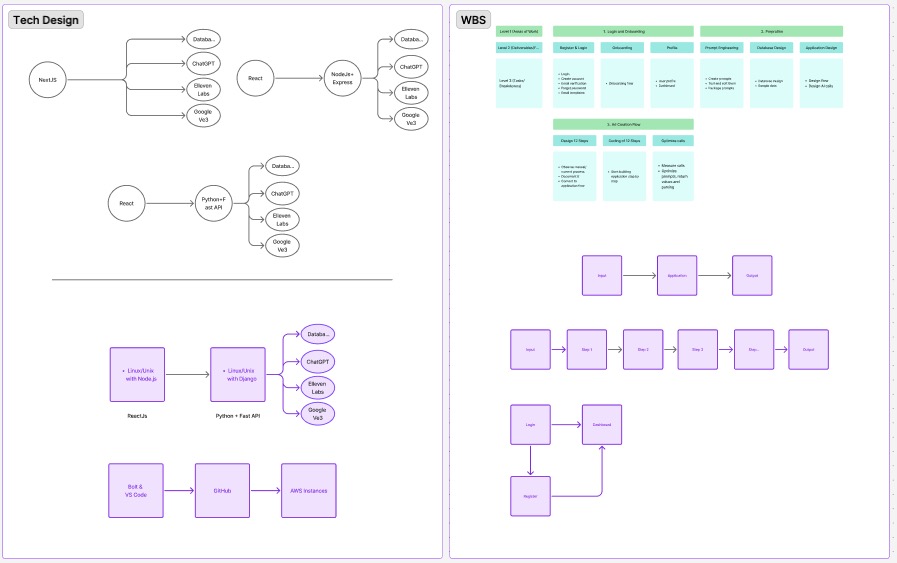
The Tech Stack Decision: 4 POCs Later
Once we committed to the idea, I faced a critical question: What's the right tech stack for a video ad platform that needs to scale?
Instead of guessing, I built four different proof-of-concept applications to test our options:
POC #1: Next.js Full-Stack
What it was: Frontend and backend in a single Next.js application
Pros: Fast to build, single codebase
Cons: Security concerns, harder to scale independently
POC #2: React + Node.js (Express)
What it was: Separated frontend (React) and backend (Node.js/Express)
Pros: Clean separation, same technology stack (JavaScript)
Cons: Missing Python's AI/ML advantages
POC #3: React + FastAPI (Python)
What it was: React frontend with Python FastAPI backend
Pros: Python's AI integration, fast performance, clean API design
Cons: Two different technology stacks to maintain
POC #4: React + Django
What it was: React frontend with Django backend
Pros: Mature Python framework
Cons: Too much overhead for our focused API needs
The Winner: React + Python FastAPI
After testing all four approaches, we chose React + FastAPI.
Why Python won:
- AI Integration: Python integrates more effectively with AI tools
- Performance: Faster execution for data processing
- Ecosystem: Rich libraries for video and image processing
- Future-proofing: Better positioned for ML features
The Trade-off: Node.js would have kept us in a single technology ecosystem (JavaScript), making it easier to onboard new developers. But the AI advantages of Python outweighed the team complexity.
Pro tip: Build POCs before committing to architecture. The few days spent testing saved us weeks of potential refactoring.
Infrastructure: AWS Lightsail and the $1,000 Credit
For hosting, I went through a similar research and testing process.
Options considered:
- Heroku (familiar but expensive)
- Railway (good DX)
- AWS EC2 (powerful but complex)
- AWS Lightsail (AWS simplified)
Why Lightsail won:
- Expert input: My friend Piyush Sachdeva (13+ years in cloud) recommended it
- Scalability: AWS won't limit us when we need to grow
- Cost advantage: My friend Vishal suggested applying for AWS Startup Credits—we got $1,000
- Learning opportunity: Wanted hands-on AWS experience
The Tools Behind the Scenes
Here's my exact toolchain for rapid development:
AI Coding:
- Bolt.new for rapid prototyping
- VS Code + GitHub Copilot for backend Python development
- Cursor for advanced AI assistance
Design and Planning:
- Figma for wireframes and mockups
- FigJam for brainstorming and process mapping
AI Services:
- OpenAI for text processing
- Anthropic for advanced reasoning
- ElevenLabs for voice synthesis
- Flux1, Kling, Veo 3 for video generation
Collaboration:
- Loom for async video updates
- Google Docs for documentation
- Google Chat for team communication
Building in Public: The Documentation Strategy
Here's something I'm doing differently: documenting everything in public.
My content so far:
- 9+ YouTube videos covering the entire journey
- Daily updates on X and LinkedIn
- Behind-the-scenes content showing pivots, struggles, and wins
Why I'm doing this:
- Accountability: Public commitment drives execution
- Community building: Helping other hackathon participants
- Learning in public: Sharing the messy, non-linear reality of building
- Network effects: Attracting advisors, users, and potential team members
The response has been incredible. Other builders are sharing their own struggles, offering advice, and collaborating on solutions.
You can find all my videos here.
Current Status and What's Next
We're about halfway through the hackathon timeline. Here's what the next 15 days look like:
Immediate Goals:
- Complete V1 development of core video ad generation features
- Launch closed beta with interested agency owners and business owners
- Gather user feedback and iterate rapidly
Early Traction:
We already have interest from several business owners and agency leads who want to test the platform. This early validation is encouraging—we're building something people actually want to use.
Success Metrics:
- User engagement in closed beta
- Time saved versus manual ad creation
- Quality of generated ads compared to manual process
- User retention and feedback scores
Key Lessons for Startup Builders
1. Kill Ideas Fast
Don't fall in love with ideas—fall in love with problems. We could have spent months building the Shopify SEO tool, only to launch into a crowded market. Research saved us.
2. Build POCs Before Committing
Architecture decisions are expensive to change. Spending a few days building proof-of-concepts saved weeks of potential refactoring.
3. Leverage Domain Expertise
Having Victor's deep agency experience is our competitive advantage. Find partners who understand the problem space intimately.
4. Document Everything
Building in public creates accountability, attracts help, and builds your network. The documentation process also clarifies your own thinking.
5. Validate Early and Often
We're already talking to potential users before the product is finished. Don't wait for perfection—get feedback early.
The Reality of Building
Here's what startup content rarely talks about: building is messy.
- Ideas don't work linearly
- Technical decisions have trade-offs
- Market research sometimes tells you to stop
- Pivots are normal, not failures
This hackathon isn't just about building a product—it's about learning to make better decisions faster. Every killed idea, every POC, every pivot is data that makes us better builders.
Want to Follow Along?
If you're building something yourself, especially if you're in this hackathon, I'd love to hear what you're working on.
And if anything I've shared is useful for your own journey, reach out. The startup community thrives when we help each other succeed.
Follow my real-time updates:
- YouTube: @vinodshsharma
- X: @vinod_sharma
- LinkedIn: Connect with me
The next two weeks are going to be intense. We're moving from research and architecture into full execution mode. I'll keep sharing the wins, the struggles, and everything in between.
Because that's the real story of building—and it's messier and more interesting than most people let on.
What's the hardest part of your own building journey? The technical decisions, the market validation, or something else entirely? I'd love to hear your story.