Most people set goals they never achieve.
January comes, everyone makes resolutions. By March, those resolutions are forgotten. Sound familiar?
I used to be the same way. I'd set ambitious goals, feel motivated for a week, then get overwhelmed and give up.
Then I discovered the power of quarterly planning.
Instead of setting yearly goals that feel impossible, I break everything down into 12-weekly focused sprints. This approach changed everything for me.
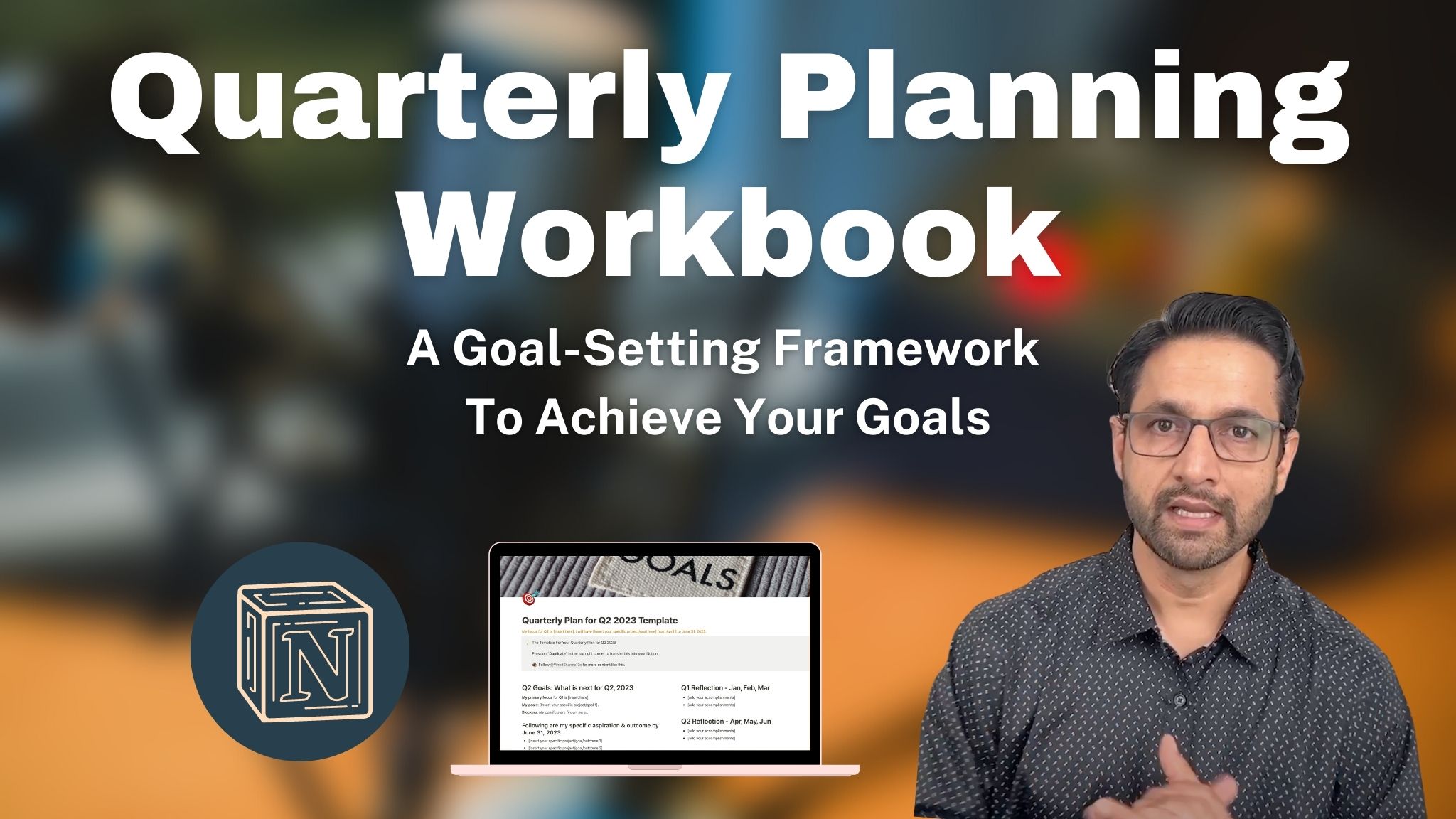
Today, I'm sharing the exact 5-step system I use to plan and achieve my quarterly goals. Plus, you'll get the complete workbook template I've been using for years.
Why Quarterly Planning Works Better Than Annual Goals
12 weeks is the perfect timeframe.
1 month (Too short): Not enough time for meaningful progress
1 year (Too long): Goals feel abstract and distant
3 months (Just right): Long enough for real progress, short enough to stay focused
What makes quarterly planning powerful:
- Urgency without panic: 12 weeks creates healthy pressure
- Clear milestones: You can see progress every week
- Course correction: Quarterly reviews let you adjust before it's too late
- Momentum building: Completing quarters builds confidence for bigger goals
I've used this system to:
- Launch multiple products
- Build consistent content creation habits
- Improve my health and fitness
- Grow my professional skills
- Strengthen personal relationships
The secret isn't motivation. It's having a system that works.
The Problem with Traditional Goal Setting
Most goal-setting advice is broken.
Traditional approach:
- Write down big goals
- Hope motivation carries you through
- Feel guilty when you inevitably fall behind
- Give up and try again next year
Why this fails:
- No clear action plan
- No consideration of conflicts and obstacles
- No weekly breakdown of what to do
- No system for daily consistency
My quarterly system fixes all of these problems.
The 5-Step Quarterly Planning System
Step 1: Brain Dump Everything You Want to Do
Before you can focus, you need to see everything.
List all goals, projects, and tasks across every area of your life:
- Family: Spend more quality time with spouse/kids
- Health: Lose weight, exercise regularly, eat better
- Work/Career: Get promoted, learn new skills, build portfolio
- Business: Launch product, grow audience, increase revenue
- Finances: Save money, pay off debt, invest for future
- Hobbies: Learn guitar, read more books, travel
- Friends: Reconnect with old friends, make new ones
- Spirituality: Meditate daily, attend services, practice gratitude
- Home: Organize garage, renovate kitchen, declutter
Don't filter yet. Write everything down.
Create your wish list too:
- Everything you want to do this quarter
- Everything you want to do this year
- Everything you want to do someday
Example brain dump:
- Launch my side project
- Write 12 blog posts
- Exercise 4 times per week
- Read 6 books
- Learn React Native
- Organize home office
- Plan family vacation
- Pay off credit card debt
- Start investing in index funds
- Learn photography
The goal is to get everything out of your head and onto paper.
Step 2: Pick 1-2 Goals That Matter Most
This is the hardest step. And the most important.
Evaluate each potential goal using these criteria:
- Passion: Which goal excites you most?
- Purpose: Do you have a strong "why" for this goal?
- Achievability: Can you realistically achieve it in 12 weeks?
- Impact: What positive changes will this create in your life?
- Readiness: Can you start working on it now?
Rank your top 5-10 goals using these criteria.
Then pick only 1-2 goals for the quarter.
Why so few? Because focus creates results. Trying to achieve 10 goals means achieving none of them well.
Make your chosen goals SMART:
- Specific: Exactly what will you accomplish?
- Measurable: How will you track progress?
- Achievable: Is it realistic in 12 weeks?
- Relevant: Does it align with your bigger vision?
- Time-bound: When exactly will you finish?
Good goal examples:
- Lose 15 pounds by March 30th (specific, measurable, time-bound)
- Write and publish 12 blog posts by quarter-end (action-based, trackable)
- Launch my productivity app with 100 beta users by March 31st (specific outcome)
- Save $5,000 for emergency fund by end of Q1 (measurable, time-bound)
Bad goal examples:
- "Get healthier" (too vague)
- "Make more money" (no specific target)
- "Be more productive" (not measurable)
Step 3: Define Your "Why" and Identify Blockers
Goals without strong reasons fail.
For each chosen goal, write:
Your Why (Positive Impact):
- What will achieving this goal do for your life?
- How will you feel when you accomplish it?
- What opportunities will this create?
Example: "By losing 15 pounds, I'll have more energy, feel confident in my clothes, and reduce my risk of health problems. I'll set a good example for my kids and feel proud of my discipline."
The Cost of Not Achieving (Negative Impact):
- What happens if you don't work on this goal?
- What opportunities will you miss?
- How will you feel in 12 weeks if nothing changes?
Example: "If I don't lose weight, I'll continue feeling tired and self-conscious. My health risks will increase, and I'll regret not taking action when I had the chance."
Potential Blockers:
- What could prevent you from achieving this goal?
- What obstacles typically derail you?
- What conflicts might arise?
Common blockers:
- Time constraints (work getting busy)
- Competing priorities (family obligations)
- Lack of skills (need to learn new technology)
- External factors (economic downturn affecting business goals)
- Bad habits (staying up late affecting morning workouts)
Identifying blockers helps you plan around them instead of being surprised by them.
Step 4: Create Your 12-Week Action Plan
Goals are achieved through weekly progress.
Break your quarterly goal into 12 weekly mini-goals.
For a weight loss example:
- Goal: Lose 15 pounds in 12 weeks
- Weekly target: Lose 1.25 pounds per week
- Weekly actions:
- Exercise 5 times (specific workouts)
- Track all food intake
- Drink 1 gallon of water daily
- Meal prep every Sunday
For a product launch example:
- Goal: Launch productivity app with 100 beta users
- Weekly breakdown:
- Week 1-2: Complete MVP features
- Week 3-4: Internal testing and bug fixes
- Week 5-6: Design landing page and onboarding
- Week 7-8: Launch beta program and recruit first users
- Week 9-10: Gather feedback and iterate
- Week 11-12: Marketing push to reach 100 users
Your weekly plan template:
Week 1:
- [Specific actions and outcomes]
- [Specific actions and outcomes]
Week 2:
- [Specific actions and outcomes]
- [Specific actions and outcomes]
Week 3:
- [Specific actions and outcomes]
- [Specific actions and outcomes]
...continue for all 12 weeks and make each week specific enough that you know exactly what to do.
Step 5: Design Your Daily Action System
Goals are achieved through daily habits.
Turn your actions into automatic habits rather than relying on motivatio
For each goal, identify:
Daily Actions:
- What specific actions will you take every day?
- When exactly will you do them?
- How will you make them automatic?
Weight loss daily actions example:
- Water: Fill 1-gallon bottle every morning, finish by bedtime
- Exercise: Workout at 6 AM Monday-Friday (specific routine planned Sunday)
- Food: Log every meal in MyFitnessPal immediately after eating
- Tracking: Weigh myself every morning and log in spreadsheet
Product development daily actions example:
- Code: Write code for 2 hours every morning before work (5-7 AM)
- Progress: Update project board every evening with tomorrow's priorities
- Learning: Watch one technical tutorial during lunch break
- Networking: Reach out to one potential beta user daily
Habit stacking: Attach new habits to existing routines.
- "After I pour my morning coffee, I will open my code editor"
- "After I brush my teeth at night, I will plan tomorrow's priorities"
Environment design: Set up your environment for success.
- Lay out workout clothes the night before
- Keep healthy snacks visible and junk food hidden
- Set up your workspace the night before coding sessions
How to Use This System Effectively
Weekly Reviews (15 minutes every Sunday)
Review last week:
- What went well?
- What didn't work?
- What obstacles came up?
- What did you learn?
Plan next week:
- What are your specific targets?
- What potential obstacles do you see?
- How will you handle them?
- What adjustments do you need to make?
Monthly Check-ins (30 minutes)
Assess progress:
- Are you on track for your quarterly goal?
- What's working better than expected?
- What's harder than anticipated?
- Do you need to adjust your approach?
Course correct:
- Modify weekly targets if needed
- Adjust daily actions based on what you've learned
- Address persistent obstacles
- Celebrate progress made
Quarterly Reviews (2 hours)
Complete assessment:
- Did you achieve your goals? Why or why not?
- What systems and approaches worked best?
- What would you do differently next time?
- What did you learn about yourself?
Plan next quarter:
- What goals carry forward?
- What new opportunities have emerged?
- How will you apply lessons learned?
- What support do you need?
Common Mistakes to Avoid
Mistake 1: Choosing Too Many Goals
Problem: Trying to transform your entire life in one quarter
Solution: Focus on 1-2 goals maximum. Master the system with fewer goals first.
Mistake 2: Setting Vague Goals
Problem: "Get healthier" or "make more money"
Solution: Be specific. "Lose 15 pounds" or "earn $2,000 in side income"
Mistake 3: No Weekly Breakdown
Problem: Having a big goal with no intermediate steps
Solution: Plan what you'll accomplish each week to reach your quarterly target
Mistake 4: Ignoring Obstacles
Problem: Assuming everything will go perfectly
Solution: Identify potential blockers and plan how to handle them
Mistake 5: No Daily System
Problem: Relying on motivation instead of building habits
Solution: Design specific daily actions that become automatic
Mistake 6: Skipping Reviews
Problem: Setting goals then never checking progress
Solution: Weekly reviews are non-negotiable. They keep you on track.
Your Next Steps
Ready to start your own quarterly planning system?
This Week:
- Download the workbook
- Schedule 2 hours for your quarterly planning session
- Complete Steps 1-3 (brain dump, goal selection, why/blockers)
Next Week:
- Complete Steps 4-5 (weekly plan and daily actions)
- Set up your tracking system (spreadsheet, app, or journal)
- Start your daily actions immediately
Week 3 and Beyond:
- Implement weekly reviews every Sunday
- Track your progress daily
- Adjust as needed based on what you learn
The Truth About Goal Achievement
This system works, but only if you work the system.
The magic isn't in the planning. It's in the consistent execution.
You don't need perfect conditions. You don't need unlimited time. You don't need superhuman discipline.
You need:
- Clear goals with strong reasons
- A weekly plan that guides your actions
- Daily habits that build momentum
- Regular reviews that keep you on track
Most people fail at goals because they skip the system and rely on motivation.
You're going to succeed because you have a system that works even when motivation fades.
What will you accomplish in your next 12 weeks?
The best time to start was last quarter. The second best time is now.
Ready to turn your goals into reality? Download the complete quarterly planning workbook and start your most productive quarter yet.